



















































|
Return to 2004 Chafee Lecture Home THE JOHN H. CHAFEE MEMORIAL LECTURE Lessons from Environmental Collapses Of Past Societies
Dr. Jared M. Diamond University of California, Los Angeles
It’s a great pleasure and honor to be with you this evening, among admired old friends and new friends, to present the Fourth Annual John H. Chafee Memorial Lecture on Science and the Environment, sponsored by the National Council for Science and the Environment. I have at least three associations with this occasion.
First is a personal association with Steve Hubbell, whom I met 20 years ago, when his recent great book was still just a germ of an idea and being worked out in its early stages. Steve and I share a passion for biogeography. Second, the National Council is dedicated to improving the scientific basis for environmental decisionmaking, and that’s the area to which I’ve devoted much of my own time and efforts over the last two dozen years. Finally, John Chafee dedicated himself to translating environmental science into public policy.
I also feel another, much more specific, bond with John Chafee and with his legacy, although I did not know him personally. It’s a bond that may seem strange to those of you born after 1945. Both John Chafee and I spent intense, fascinating, formative months of our lives in the jungles of the southwest Pacific island of Guadalcanal in the Solomon Islands. I was in those jungles in 1974 and 1976, studying birds. John Chafee was there during World War II, in 1942, and he was not studying birds. I found the jungles of Guadalcanal difficult enough to get around in, even though nobody was shooting at me. John Chafee must have found those jungles even more difficult, because people were shooting at him. I was only 5 years old when John Chafee landed on Guadalcanal, but the images of the Guadalcanal campaign that came to me through the newspapers and radio formed my fantasy life and the fantasy life of my schoolmates as we were growing up. Thirty-two years later, I, too, found my firsthand experience of those jungles unforgettable. When my wife and I were planning our wedding and wanted to pick a wedding date that had extra meaning, we chose to be married on the 40th anniversary of the American recapture of Henderson Airfield on Guadalcanal in 1942.
I’d like to tell you this evening about an area in which both the natural sciences and the social sciences can inform public policy. It’s the area of my next book, which should be published in January 2005. The book took off from a mystery, the mystery of ancient civilizations that collapsed — like Angkor Wat and the Maya cities — leaving behind abandoned monuments. By collapse of a society, I mean a drastic decrease in human population numbers and/or in political, economic, and social complexity over a large area for a long time.
Why do societies collapse? That question presents a romantic mystery, but it also presents the big intellectual and scientific problem of why some societies collapsed, while others did not. Even more than being a romantic mystery and an intellectual and scientific problem, it’s an important problem of public policy. There is overwhelming recent evidence from archeology and other disciplines that some mysterious collapses consisted of self-inflicted ecological suicides. These were a result of human impacts on the environment, causing problems similar to the environmental problems that we face today, even though those past societies that eventually did collapse had far fewer people and far less potent destructive technology than we have today.
Possible cases of societies that destroyed themselves in the past because of an inability to master their environmental problems include the societies of the Fertile Crescent, where agriculture and metal tools arose, Mycenaean Greece, Easter Island and some other Pacific Islands, the Western Roman Empire, Classic Lowland Maya civilization, the Anasazi in our Southwest, Angkor Wat in Cambodia, Great Zimbabwe in Africa, Cahokia near modern St. Louis, Norse Greenland, Harappan Indus Valley civilization, and so on.
These collapses are relevant to the environmental problems that we face today. Current environmental problems include the water problems on which this conference is focusing, and also problems of deforestation, the impending end of the tropical rain forests, overfishing, soil erosion, soil salinization, global climate change, full utilization of the world’s fresh water supplies, our approach to a photosynthetic ceiling, exhaustion of cheap energy resources, accumulation of toxic chemicals in water, food, and soil, increase in human population, and increase in the per capita impact of our population. Many of those factors are what destroyed past societies, and they are the main threats to us today. What can the past teach us about why some societies are more unstable than others?
What can the past teach us about how some societies did succeed in overcoming their environmental problems? Of course, there are societies that did not collapse, and that remained intact over a long time, such as Japan, Tikopia Island, Tonga Island, and the New Guinea highlands. Human society has been going on there for thousands of years without any signs of an environmental collapse. What is it, then, that makes some societies more fragile than others? Is it that some societies have the misfortune to occupy fragile environments, or is it instead that the societies themselves were organized in a non-adaptive way, or do both of those factors explain the collapses or successes?
Environmental problems don’t exist in isolation. They interact with climate change, for example. If a society is hammering its environment, it may be able to get away with it as long as the climate is in its favor, but the society may collapse when the climate gets cold or hot or dry or wet.
Environmental problems also interact with trade with friendly neighbors. A society may depend for support on friendly neighbors, and so it may collapse if the neighbors collapse from their own environmental problems. Think of the 1973 Gulf oil crisis and its risk to us.
Societies also face problems with attacks by hostile neighbors. If a society is weakened by its own environmental problems, then hostile neighbors may use the opportunity to step in and destroy a society that previously had been strong enough to oppose them. For example, there has been a long-standing argument whether the fall of the Western Roman Empire was really caused by hostile barbarians or whether those barbarians just dealt the final blow to a Rome weakened by internal factors.
Finally, there’s the question of a society’s responses. When a society is facing environmental problems, what are the political, economic, social, and cultural reasons that enable some societies to solve their problems and that prevent other societies from solving them?
This evening I’m going to talk only about deforestation, which is really just one of the 12 major environmental threats that we face today. There will be four parts to my talk. First, I’ll give you an example of a society that did collapse because of inadvertent deforestation: Easter Island in the Pacific Ocean. Then I’ll talk about the natural science aspect of the collapse. Why is it that Easter Island was extreme among Pacific Islands? Third, I’ll talk about the social science aspect of this. Why is it that Easter Islanders, and only some other societies, made mistakes? Finally, I’ll talk about policy outcomes as regards forestry management in the modern world.
 Let’s start with Easter Island. It’s a remarkable place, but not many of us have been there because Easter Island is the most remote habitable scrap of land in the world. It’s an island in the southeastern Pacific Ocean, 2,300 miles west of the coast of Peru, and 1,300 miles east of Pitcairn and Henderson Island. It’s a very isolated human society in a fragile environment. Easter Island is relatively dry, receiving only 40 inches of rain per year, and as I’ll also explain to you, that’s only one of Easter’s problems.
Easter is best known for the famous mystery of its giant stone statues. These statues on average weigh 12 tons but can be as heavy as 270 tons. They average 10 or 15 feet tall. The biggest one erected was 32 feet tall, and there was one of 70 feet, the height of a five-story building, that was not successfully erected. Those gigantic stone statues were transported as far as nine miles from the quarries where they were carved. All this was done by Polynesians with only stone tools — no metal tools, no draft animals, no domestic animals other than chickens, no wheels — and only human muscle power. It’s been a mystery for a long time: how and why did the islanders carve and erect the statues? When Europeans discovered Easter Island in 1722, the islanders themselves were in the process of pulling down and breaking those statues that their ancestors had erected with such enormous effort. So, who erected them, how, and why did they then tear them down?
The ecological origins of the collapse of Easter Island society became clear beginning 20 years ago, through studies by paleobotanists. Easter is barren today. There are no native trees on Easter Island more than seven feet tall. That was something that already puzzled the first European to visit Easter, the Dutch navigator Jakob Roggeveen, who arrived there in 1722 on Easter Day and saw these gigantic statues. He wrote in his diary that, to transport and erect them, the islanders must have required wood and rope, but there were no trees to provide the wood and rope. Where were the necessary trees?
Today the only trees belong to exotic species brought in during the 20th century. But studies of sediment at the bottom of swamps and ponds on Easter Island, and identification of pollen grains in those sediments, show that when Polynesians originally settled the island around A.D. 800 it was covered by a tropical forest. There were at least two dozen species of trees, including a relative of the Chilean wine palm that was formerly the world’s largest palm tree. The Chilean win palm is now the largest living palm tree at three feet in diameter, but the Easter Island palm could reach seven feet in diameter and at least 65 feet tall.
The island today also has no native land birds whatsoever. There is only one sea bird that breeds on Easter Island itself. But, again, studies of the bones of birds in archeological deposits show that Easter Island used to have at least six species of native land birds, including parrots and rails and owls, and at least 25 breeding sea bird species.
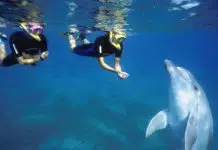
After Polynesians settled the island in A.D. 800, they of course began to clear the forest for a number of reasons. They cleared the forest for gardens because they were farmers. They cleared the forest for firewood, and for big logs out of which to make their dugout canoes to go fishing. Evidence of those ocean-going canoes that they must have had lies in the fact that, in the bone deposits in early Easter Island middens, the most common food item was dolphins. Yet dolphins don’t come close to the shore of Easter Island. In order to catch or harpoon dolphins, the islanders would have had to go far offshore in dugout canoes. This is the only Pacific Island diet in which dolphins played a big role.
People also hunted the land birds, hunted the sea birds, and ate the fruit of the palm trees. The palm trees were also used to transport the statues. Statues were transported on prepared roads with wooden crossbeams and then dragged over the roads. Then, logs from the now extinct forest were used to lever the statues into a vertical position. The forest thus was necessary for providing the beams to transport and erect the statues. Also, out of the bark of one of the species of trees, Easter Islanders obtained natural rope that was used to drag the sleds on which these statues were mounted.
The population grew after settlement in A.D. 800 until it reached at least 15,000, maybe 30,000 people. By the time that Easter’s population peaked around 1620, all of the trees had been cut down and were extinct. All of the land birds were extinct, and only one of the sea bird species was left on the island itself. The elimination of the forest, and also of the birds, had practical consequences for the islanders. Without trees they could no longer transport or erect their statues. The last statue was put up around 1620. Without trees they didn’t have any firewood, except for agricultural wastes. Again, archeological middens show us that, early on, the islanders were burning charcoal from the native trees, but at the end of the archeological sequence they were reduced to burning sugar cane scraps. Without trees, they lacked mulch and other fertilizers to fertilize their gardens, and so agricultural yields for their crops decreased. Without trees they had no canoes, so they couldn’t go out to sea to hunt dolphins. By then, they had hunted the last of the sea birds. Around 1680, according to Easter Island oral tradition, there was a revolution. Until then, Easter Island had been a chiefdom with a paramount chief, and the chiefs claimed a connection to the gods by divine descent. They thereby claimed the ability to bring prosperity, crops, and rain. When the chiefs, because of the destruction of the forest, were no longer able to bring prosperity, and people started starving, there was a revolt. The chiefs were overthrown, and a new caste of military leaders took over.
With the end of availability of dolphins as the largest animal edible on Easter Island, Easter Islanders turned to the next largest animal available to them: humans. Easter Island society collapsed in an epidemic of cannibalism. Traditionally, the worst insult that you could say to an Easter Islander was, “The flesh of your mother sticks between my teeth.� That’s a relic from that cannibal era.
There was then a population crash. Between 70 and 90 percent of the population died out. And after the crash there was no possibility of rebuilding the society, because the trees and the soil fertility that were the society’s basis had been undone.
While there are other past societies that destroyed themselves, I have found that the story of Easter Island grabs my students and readers more than that of any other society, because the metaphor is so clear. Easter Island was isolated in the Pacific Ocean. Once the trees were cut down and people had no more canoes, they couldn’t escape — there was nowhere to go when they got into trouble. Easter Island was so remote that there was nobody to come help them. Easter Island isolated in the Pacific Ocean is seen as a metaphor for Planet Earth isolated in the universe. If we too get into trouble, there’s no place we can go, and nobody will come to help us.
I keep saying to myself, somebody must have cut down the last palm tree. What did the Easter Islander who cut down the last palm tree say? Did he shout, “What about our jobs? Do you care more for trees than for people?� Or maybe he said, “Respect private property rights! Get the big government of the chiefs off our backs.� Or, perhaps that last islander said, “You predict environmental disaster, but your environmental models are untested. We need more research.� Or, perhaps his words were, “Never fear, technology will solve our problems somehow. We shall find substitutes for wood.�
There were, however, thousands of other Pacific islands besides Easter Island. Why was it Easter that was the site of the worst population crash? And why was it one of the worst examples of deforestation in the Pacific? Those thousands of Pacific Islands began to be settled by humans around 1200 B.C., and the last of them, New Zealand, was settled around A.D. 1200. Out of those thousands of islands occupied by people, the only ones that approached Easter in its degree of deforestation were Nihoa in the Hawaiian group, where one palm species survived, and Necker in the Hawaiian group, where no trees survived. Those three islands, then, were virtually deforested.
Other Pacific islands that were largely but not completely deforested included Mangareva, most of the Cook and Austral islands, and the leeward sides of the big Hawaiian and Fijian islands. Then there were Pacific islands where primary forest remained at high elevation and where there were secondary forests and grasslands and ferns at low elevation. That was the case in the Societies, Marquesas, and the windward sides of the big Hawaiian and Fijian islands. Finally, there were Pacific islands that even on European arrival were still largely covered with forest, such as Tonga, Samoa, Makatea, the wet side of New Zealand’s South Island, and most of the Bismarck and Solomon islands.
Why all this variation? Why did some islands get completely deforested, some largely deforested, some partly deforested, and some barely deforested at all?
I’ve been collaborating for the past couple of years with the archeologist Barry Rolett at the University of Hawaii. Barry assembled a wonderful database from the logs of early explorers and European visitors. He tabulated the forest cover at the time of European contact on 81 Pacific Islands, representing the outcome of deforestation before European arrival. We also tabulated nine physical variables that we thought might be connected to the degree of deforestation, in order to understand the environmental factors underlying fragility. Then we did statistical analyses of our 81 data points and our nine independent variables. We did correlation analysis, multiple regression, residual analysis, and tree analysis.
We correctly anticipated six environmental variables whose variation among Pacific Islands we thought would be predictive of deforestation. The two most important, as we expected, were rainfall and latitude. You might expect that on a wet island when you chop down trees, new trees will grow up quickly, so the forest may reach a steady state of re-growth against logging. The other most important variable governing plant re-growth besides rainfall is temperature. Trees grow faster on a hot island, like New Guinea, than on a cold island, like New Zealand’s South Island or Easter Island. A conclusion of our statistical analysis was thus that the degree of deforestation increased with decreasing rainfall and increased with latitude, meaning as it got colder. Four other effects we also anticipated correctly. We anticipated that higher-elevation islands would be less deforested than low islands, for a number of reasons. High islands produce what is called orographic rain, which comes down to the lowlands as streams, carrying nutrients and dust. We expected that remote islands would be more deforested than islands with neighboring islands, because remote islands didn’t have any escape valve where any human population surplus could bleed itself off. We anticipated that big islands would end up less deforested than little islands, again, for a number of reasons, such as that it takes more time to chop down the forest on a big island, that a big island has a higher area-to-perimeter ratio and so lower human population densities and less impact, and a big island is more likely to have some areas unsuitable for gardens. A sixth variable that we predicted correctly was the presence of a coral terrain called makatea, which is just awful to get around in, razor sharp, and hard to log, and we were right in anticipating that makatea islands would end up less deforested. There were also environmental variables predictive of deforestation that we hadn’t anticipated. One is island age. Older islands ended up more deforested than young islands, and the reason is that these Pacific Islands are volcanic, and the older the island and the longer the time since the last volcanic activity, the more time there’s been for rain to leach the nutrients out of the soil. Low nutrient levels in the soil may then become rate-limiting for regrowth of vegetation.
Another surprise to us was what happened on islands west of what geologists call the Andesite Line of the Pacific. Volcanoes west of that line blow out ash that can be carried in the winds for a thousand miles, while islands east of the line, such as the Hawaiian Islands, don’t blow out ash but produce lava, which is not carried in the wind. West of the Andesite Line, ash from volcanoes can get carried for long distances and restore soil fertility, even on old islands. Our observation was that islands west of or near the Andesite Line therefore got less deforested than islands far east of the Andesite Line, because of higher soil fertility.
The final surprise was that dust fallout from Central Asia was the ninth predictor. From the steppes of Central Asia, dust is carried up into the atmosphere and is blown east across the Pacific. The further east you get in the Pacific, the cleaner the air gets because more dust has fallen out. So the least dust fallout in the Pacific is on the easternmost of the Polynesian islands, Easter Island. Deforestation then increases, going eastwards, in part because of decreasing dust fallout.
Those then were the nine predictive variables, the nine environmental risk factors, for deforestation. So why was Easter Island deforested? It was fragile on all nine counts. It’s not that Easter Islanders were especially stupid or imprudent, but that they had the misfortune to be living in the most fragile Pacific environment. Easter Island has the third highest latitude of Polynesian islands. It has the lowest ash fallout because it’s furthest from the Andesite Line. It has the lowest Asian dust fallout, the second greatest isolation, it’s a relatively dry island, somewhat low in elevation, somewhat small in area, and the island is a mosaic of an old volcano and a younger volcano. The old volcano of Easter got deforested first. Easter Island has none of the awful makatea terrain to act as a refuge for forest.
Thus, the Easter Islanders had the decks stacked against them. Those are the environmental factors predicting deforestation in the Pacific. When you put those nine factors back into our regression equations, the equations predict correctly that the worst deforestation in the Pacific should be on Easter, Nihoa (the island with one palm tree left), and Necker Island.
So, one can draw on the natural sciences to understand why some environments are more fragile than other environments. But one has to ask, why does a society make mistakes? One can draw on the social sciences to try to understand why some people make mistakes and others don’t. As the Easter Islanders were cutting down the forest, you would think that the chiefs and the people themselves would have known perfectly well that they were cutting down the forests on which they depended for firewood and to transport statues and canoes. Why didn’t someone say,“Stop it!�? That was a failure of group decisionmaking.
There are lots of other examples of such failures. There were two interesting episodes of group decisionmaking by President Kennedy and his advisors. Their group decisionmaking at the time of the Bay of Pigs was disastrous. After the Bay of Pigs, Kennedy brought together a group of advisors to figure out not only what specifically had gone wrong at Bay of Pigs, but also what had gone wrong with his decisionmaking, and he changed the decisionmaking process so that at the time of the Cuban missile crisis, the thinking and the group decisionmaking were different, with a happier outcome.
Another disaster of group decisionmaking was the introduction of rabbits into Australia. Can you believe that Australians intentionally introduced rabbits? In fact, it took them five tries, since the rabbits went extinct after the first four tries. Rabbits today consume half of the pasture vegetation of Australia.
Many societies, including ours today, overfish. Why do we make these mistakes? As another example, consider the looting of American businesses by their CEOs in recent years. Why do the businesses do this? Why does American society set itself up in a way that this is possible? It’s a problem in the social sciences, why groups end up making decisions that are disastrous for the group.
I’ve arrived at a hierarchy, a sequence of four decision points, that may result in good or bad decisionmaking. The first decision point is whether or not a society anticipates a problem. A society or a group may fail to anticipate a problem before the problem appears, especially if they’ve had no prior relevant experience of such problems. Australians introduced rabbits because they didn’t know the bad things that introduced animals could do. Similarly, the Vikings, when they arrived in Iceland, ended up deforesting Iceland because they were not used to an environment with light soils laid down by volcanoes. They were used to the heavy soils of Norway, which did not blow away, so they could not anticipate problems of deforestation in Iceland. The Easter Islanders came from wet, high, equatorial islands, and they were not able to anticipate the problems of dry, low, high-latitude islands.
The next decision point is failure to perceive a problem when the problem has arrived. Some problems are literally imperceptible. You can’t see salinization of soil without measuring instruments. Leaching of soil nutrients in Australia, again, was invisible. There also are problems that are virtually invisible because they involve a small or slow signal, which gets buried in lots of up-and-down noise and fluctuations. For instance, it’s only within the last few years that most previously unconvinced scientists have been willing to admit that global warming is a real phenomenon. Untilthen, there were legitimate grounds for doubt whether, given the wiggles of global temperature up and down each year, we would need a longer record in order to convince ourselves that global warming is real. Our current President still is not convinced.
A third reason why a group may fail to solve a problem, even when it has perceived the problem, is that it may not even try to solve the problem because of what’s called rational behavior on the part of a group — that’s to say clashes of interest. This behavior was especially surprising to me, but it turns out to be common. One such example of a clash of interest is the socalled tragedy of the commons, i.e., the overfishing or overharvesting of a common resource. This problem of clashes of interest is especially frequent where there is a decisionmaking elite that is able to insulate itself from the consequences of its action. It is then correct strategy, at least in the short-term, for the elite to loot the coffers and to take everything for themselves, even though it may in the long run be bad for their own great-grandchildren. The executives of Enron perceived quite correctly what was in their own self-interest.
Similarly, Easter Island chiefs were acting in their own self-interest. An Easter Island chief who did not cut down trees to raise a bigger and more impressive statue would have been out of a job, because the prestige of chiefs depended upon erecting statues. Similarly, the Maya kings who got into problems with deforestation were acting in their own self-interests for prestige,although in the long run it was disastrous for their kingdoms.
In addition to clashes of interest there may be clashes of values. For instance, religious values were part of the reason behind the collapse of Easter Island and Norse Greenland society. In the American West the frontier values associated with logging, mining, and ranching made sense in the 19th century, but those frontier values no longer make sense in many cases today. It’s hard for people to stop doing something that is intimately tied to their strongest held values.
Finally, a society may fail to solve a problem because some problems are just too difficult to solve, given available technology. In California we have not figured out how to eliminate introduced agricultural pests like Mediterranean fruit flies, nor have we come up with a costeffective solution for the forest fire problem in the American West.
Thus, when we try to understand the collapse of Easter Island society, there is a body of information from the natural sciences that we can draw on that helps us understand why some environments are more fragile than others. Some people are dealt a tougher deck of cards than others. We can also draw on the social sciences to understand group dynamics, and to understand why some groups solve their problems and why other groups are less likely to solve their problems.
The last thing that I want to talk about today has to do with policy implications. Given the problems of deforestation in the past dragging down societies, what can we do today to avoid modern society getting dragged down by deforestation?
Today, much deforestation is in the hands of large logging companies — big businesses. When one thinks of big businesses, it’s easy to get depressed and to feel impotent. There are lots of bad things that big businesses do. You can read the newspaper any day and see examples. As individuals we may feel helpless confronted with a corporation with a capitalization of $450 billion. What can we do if that corporation sets its mind to doing something?
Well, the fact is that corporations usually try to act in their own self-interests. Some corporations have realized that it’s in their interests to have sound environmental policies, and others have not. But in the forestry sector and in some other sectors, corporations that do practice sound environmental policies still can have an image problem. Most of us are so disillusioned with big businesses that, if a large company like an international oil company says, “We love the environment and we take good care of it,� and they put an advertisement in The New York Times saying that, none of us will believe it. Within the last few decades, it was first the oil companies and then some logging companies that recognized that they had a credibility problem, and some fisheries and a few mining companies have been coming around to the same point of view. That is, some large businesses have recognized that there are economic costs to the company, as well as to society as a whole, of destructive environmental practices.
I’ve spent a lot of time during the last four or five years talking to people — especially in the oil industry, and in the last year also to people in the mining industry — to try to find out their perception of their self-interest. They tell me that there have been wake-up calls. For the oil industry, wake-up calls included the Exxon Valdez accident, and, before that, the Santa Barbara oil spill, which warned oil companies that careless e
|